
SAT Subject Tests: Syllabus, Books, and Practice Papers; www.collegeboard.org
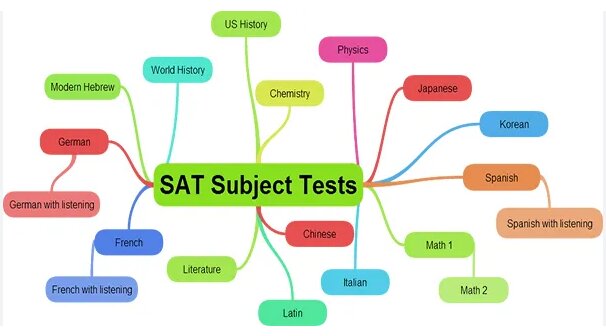
SAT Subject Tests or SAT 2 is a subject-focussed test. SAT Subject test consist of 20 multiple-choice standardized tests given by the College Board on individual subjects. SAT Subject Test comprises 5 subjects. These subjects are divided into different smaller topics. The various SAT Subjects include – Mathematics, Science, English, History, and Languages. The SAT subject test is generally taken to improve a student’s credentials for admission to the top US universities. Candidates applying to a particular course in a college can take the SAT Subject Test to exhibit his knowledge and understanding of that particular subject. However, SAT Subject Tests are no longer offered in the U.S., and has also been discontinued internationally in June .
|
Table of Contents
|
General Misconceptions in SAT Subject Tests
Candidates have many misconceptions regarding SAT Subject Tests. Here we have discussed a few of them to avoid misconceptions:
- SAT subject tests help in college admissions: The SAT Subject Tests are an influential way to highlight a candidate’s strengths in subjects like engineering, pre-med, and cultural studies.
- Colleges accept either ACT or SAT scores: The ACT and SAT exam patterns are different. Both require a different preparation strategy and skill set. Though colleges accept either of the scores, candidates must opt for anyone according to their convenience.
- No requirement for SAT subject test if SAT or ACT is taken: SAT subject tests are required by colleges for course placements. Along with other admission requirements (such as high school record, SAT scores, teacher recommendation, etc.), SAT Subject Tests help provide the academic background and interests of a candidate.
- SAT Subject Tests provide fee waivers: SAT Subject Tests do not provide any fee waiver. A good score on an SAT subject test proves your readiness in that particular subject.
ALSO CHECK
- SAT Test and Training Centers in Nigeria
- SAT Test Centers and Dates in Burkina Faso
- SAT Test Centers and Dates in Cameroon
SAT Subject Test Overview
The SAT syllabus consists of 20 SAT Subject Tests in five general subject areas: English, history, languages, mathematics, and science. Further classification of SAT exam subjects is as follows:
SAT English Subject Tests
SAT English Literature Subject Test was a 60-minute long test. It included 60 multiple choice questions which are scored out of a total of 800. Candidates opted for the SAT English Subject Test in the months of August, October, November, December, May, and June.
The English Subject Test syllabus included:
- American literature – Written by authors from the United States. The wightage of questions was 40-50%
- English literature – These were mainly written by British authors consisting of 40–50% weightage.
- Other literature in English – Previous tests have included writers from India, Ireland, Canada, and the Caribbean. This test consisted of 0-10% weightage.
SAT Mathematics Subject Tests
SAT Mathematics Subject Tests comprised two levels: Math Level 1 and Math Level 2.
SAT Math Level 1
The main focus for SAT math level 1 was algebra and geometry. Candidates needed to answer 50 multiple choice questions in 60 minutes. SAT math level 1 syllabus included:
- Algebra and functions – This section included Expressions, equations, inequalities, representation and modeling, properties of functions. The weightage was 38%–42%.
- Geometry and measurement – Coordinate: Lines, parabolas, circles, symmetry, transformations – Three-dimensional: Solids, surface area and volume were part of this section. The weightage was 38%–42%.
SAT Math Level 2
The main focus for SAT Math Level 2 Subject Test are on the areas of Algebra, Geometry, trigonometry and elementary functions (precalculus). This section consisted of 50 questions which had to be answered in 60 minutes. SAT math level 2 syllabus included:
- Algebra and functions – This included Expressions, equations, inequalities, representation and modeling, properties of functions. The weightage was 48%–52%.
- Geometry and measurement – This included Coordinate: Lines, parabolas, circles, ellipses, hyperbolas, symmetry, transformations, polar coordinates Three-dimensional: Solids, surface area and volume. The weightage was 48%–52%.
SAT Math Practice Papers
SAT Science Subject Text
SAT Science Subject Test comprised of Biology, Chemistry and Physics. In SAT exam subjects for science students, calculators were not allowed in the examination.
SAT Biology:
The SAT Subject Test for Biology included Biology Ecological and Biology Molecular. SAT Biology comprised of 80 questions that were to be answered in 60 minutes. SAT Biology syllabus included:
- Cellular and molecular biology – Cell structure and organization, mitosis, photosynthesis, cellular respiration were included.
- Ecology – Energy flow, nutrient cycles, populations, communities, ecosystems, biomes, conservation biology, biodiversity, effects of human intervention were parts of Ecology.
- Genetics – Meiosis, Mendelian genetics, inheritance patterns, molecular genetics, population genetics were included in genetics.
- Organismal biology – This included Structure, function, and development of organisms (with emphasis on plants and animals), animal behavior.
- Evolution and diversity – This included Origin of life, evidence of evolution, patterns of evolution, natural selection, speciation, classification and diversity of organisms.
SAT Biology Practice Papers
| SAT Biology Practice Test 1 | SAT Biology Practice Test 2 |
| SAT Biology Practice Test 3 | SAT Biology Practice Test 4 |
SAT Chemistry:
The SAT Subject Test for Chemistry was taken by candidates interested in studying science or engineering in college. SAT Chemistry comprised 85 questions that were to be answered in 60 minutes. SAT Chemistry syllabus included:
- Structure of matter – This included Atomic Structure, electron configurations, periodic trends Molecular Structure, including Lewis structures, three-dimensional molecular shapes, polarity Bonding, including ionic, covalent, and metallic bonds. The weightage given was 25%.
- States of matter – Gasses, including the kinetic molecular theory, gas law relationships, molar volumes, density, and stoichiometry Liquids and Solids, including intermolecular forces in liquids and solids, types of solids, phase changes, and phase diagrams. The weightage given was 16%.
- Reaction types – Acids and Bases, including Brønsted-Lowry theory, strong and weak acids and bases, pH, titrations, indicators Oxidation-Reduction, including recognition of oxidation-reduction reactions etc were parts of this subject.
- Stoichiometry – Mole Concept including molar mass, Avogadro’s number, empirical and molecular formulas Chemical Equations etc.
- Other topics included Equilibrium and reaction rates, Thermochemistry, Descriptive chemistry and laboratory.
SAT Chemistry Practice Papers
| SAT Chemistry Practice Test 1 | SAT Chemistry Practice Test 2 |
| SAT Chemistry Practice Test 3 | SAT Chemistry Practice Test 4 |
| SAT Chemistry Practice Test 5 | SAT Chemistry Practice Test 6 |
SAT Physics:
SAT Physics Subject Test was generally taken by students interested in pursuing a math, or science-based program of study (includes science, technology, engineering, or math) in college. SAT subject test physics comprised 75 questions that were to be answered in 60 minutes. SAT Physics syllabus included:
- Mechanics – This included Kinematics, includes velocity, acceleration, motion in one dimension, and motion of projectiles etc. The weightage was 36%-42%.
- Electricity and magnetism – Imporatant topics included Electric fields, forces, and potentials, includes Coulomb’s law, induced charge, field and potential of groups of point charges, and charged particles in electric fields and more. The weightage was 18%–24%.
- Waves and optics – This was one part of the syllabus which included topics like General wave properties, standing wave diffraction, and Doppler effect Reflection and refraction. The wiegtage was 15%–19%.
- Other subjects include Heat and thermodynamics, Modern physics and miscellaneous.
SAT Physics Practice Papers
| SAT Physics Practice Test 1 | SAT Physics Practice Test 2 |
| SAT Physics Practice Test 3 | SAT Physics Practice Test 4 |
| SAT Physics Practice Test 5 | SAT Physics Practice Test 6 |
SAT History Subject Test
The SAT History subject tests comprises World and U.S. History.
U.S. History:
Candidates went for the SAT U.S. History Subject tests in the months of August, October, November, December, May, and June. SAT U.S. History comprises 90 questions that are to be answered in 60 minutes. SAT U.S. History Subject Test syllabus included:
- Political history with weigtage of 31–35%
- Economic history had 13–17% weightage
- Social history contained 20–24% of the syllabus
- Intellectual and cultural history had 13–17% in the syllabus
- Foreign policy also was 13–17% .
SAT World History:
Candidates who opted for the SAT World History Subject tests were given 95 questions that were to be answered in 60 minutes. SAT U.S. History Subject Test included all historical themes namely- political and diplomatic, intellectual and cultural, social and economic from ancient times to the present.
Prehistory and civilizations to the year 500 Common Era (C.E.)
- 500 to 1500 C.E.
- 1500 to 1900 C.E.
- Post-1900 C.E.
- Cross-chronological
Geographical materials included were:
- Global or comparative
- Europe
- Africa
- Southwest Asia
- South and Southeast Asia
- East Asia
- The Americas (excluding the United States)
SAT History Practice Paper
SAT Languages
Candidates get various options to choose from for the SAT language test. The SAT Languages Subject tests are offered in the languages given below:
- Spanish
- Spanish With Listening
- French
- French With Listening
- Chinese With Listening
- Italian
- German
- German With Listening
- Modern Hebrew
- Latin
- Japanese With Listening
- Korean With Listening
SAT Subject Test Materials
SAT preparation can be aced with the help of SAT books, and practice papers and regular mock tests. SAT books provide guidance and previous years’ papers for each subject. Here are a few SAT books that are SAT subject tests required for you:
- SAT subject test study guide– Check PDF
- The College Board’s Official SAT Study Guide(2006) – Check PDF
- Kalli’s SAT Pattern Strategy – Check PDF
- McGraw Hill Education SAT Elite Edition – Check PDF
- Barron’s SAT, 29th Edition – Check PDF
- SAT Physics Subject Test– Check PDF
SAT Subjects List
Understanding the SAT: A Comprehensive Guide to Content and Structure
The SAT has undergone significant transformations in recent years, moving toward a fully digital format designed to be more accessible, shorter, and better aligned with the skills students need for college and career readiness. To succeed on the exam, it is crucial to understand that the “subjects” on the SAT are not individual, siloed tests like the old SAT Subject Tests (which were discontinued by the College Board in 2021). Instead, the modern digital SAT is organized into two primary sections that integrate various academic skills.
The Two Core Sections of the Digital SAT
The digital SAT is structured into two main sections: Reading and Writing and Math. Both sections test your ability to synthesize information, analyze data, and solve complex problems rather than just recalling rote facts.
1. Reading and Writing (RW)
This section evaluates your proficiency in reading comprehension, vocabulary, and standard English conventions. It consists of short, focused passages followed by a single multiple-choice question.
-
Craft and Structure: You will encounter questions that ask about vocabulary in context, the structure of a text, and the author’s point of view. You must understand how words and phrases function to shape meaning.
-
Information and Ideas: This requires you to analyze arguments, interpret details, and synthesize information from passages that may include tables or graphs.
-
Standard English Conventions: This tests your mastery of grammar, punctuation, and sentence structure (e.g., subject-verb agreement, modifiers, verb tense).
-
Expression of Ideas: These questions focus on refining text to be more precise, concise, and effectively organized, often asking you to complete notes or transition between ideas logically.
2. Math
The Math section focuses on the areas of mathematics that are most essential for success in college and professional environments.
-
Algebra: This is the largest portion of the Math section. It covers linear equations, systems of linear equations, inequalities, and functions.
-
Advanced Math: This focuses on quadratic, exponential, polynomial, rational, and radical equations. You will need to demonstrate facility with complex algebraic manipulations and modeling.
-
Problem-Solving and Data Analysis: This area requires you to use ratios, rates, proportional relationships, and percentages. You will also interpret data from tables, charts, and graphs, including statistical measures like mean, median, mode, and standard deviation.
-
Geometry and Trigonometry: This covers volume, area, properties of triangles and circles, and right-triangle trigonometry.
Important Clarification: The “Subject Test” Status
It is important to reiterate that SAT Subject Tests no longer exist. For many years, students took the SAT and then added specific “Subject Tests” (such as Biology, Chemistry, Literature, or History) to showcase expertise in particular disciplines.
The College Board discontinued these tests in 2021. Today, colleges look at your overall SAT score—which reflects your mastery of fundamental Reading, Writing, and Math skills—alongside your high school transcript, AP exam scores, and other achievements to gauge your academic preparedness.
How to Prepare for the SAT
Because the current SAT covers a broad range of skills rather than specific subjects, preparation requires a shift from memorization to skill-building.
-
Utilize Official Practice: The College Board partners with Khan Academy to provide free, high-quality resources, including full-length practice tests that mimic the actual digital interface.
-
Focus on Logic and Analysis: Since the questions often involve real-world scenarios, practice reading technical or scholarly texts and interpreting diverse data visualizations.
-
Master the Digital Tools: The digital SAT platform includes a built-in graphing calculator (Desmos) for the entire math section. Becoming comfortable with this tool is a massive advantage.
-
Build Your Vocabulary: While you won’t see “vocabulary word lists” in the traditional sense, understanding how sophisticated vocabulary is used in various academic contexts is vital for the Reading and Writing section.
Summary Table: Digital SAT Breakdown
| Section | Focus Areas | Key Skills |
| Reading & Writing | Craft/Structure, Info/Ideas, Grammar, Expression | Critical reading, editing, logical reasoning |
| Math | Algebra, Advanced Math, Data/Stats, Geometry/Trig | Problem solving, modeling, data interpretation |
- SAT Test Centers and Dates in Republic of the Congo
- SAT Test Centers and Dates in Egypt
- SAT Test Centers and Dates in Eritrea
- SAT Test Centers and Dates in Ethiopia
- SAT Test Centers and Dates in Gabon
- SAT Test Centers and Dates in Gambia
- SAT Test Centers and Dates in Ghana
- SAT Test Centers and Dates in Kenya
- SAT Test Centers and Dates in Liberia
- SAT Test Centers and Dates in Madagascar
- SAT Score Reporting
- New SAT could be more difficult for international students